

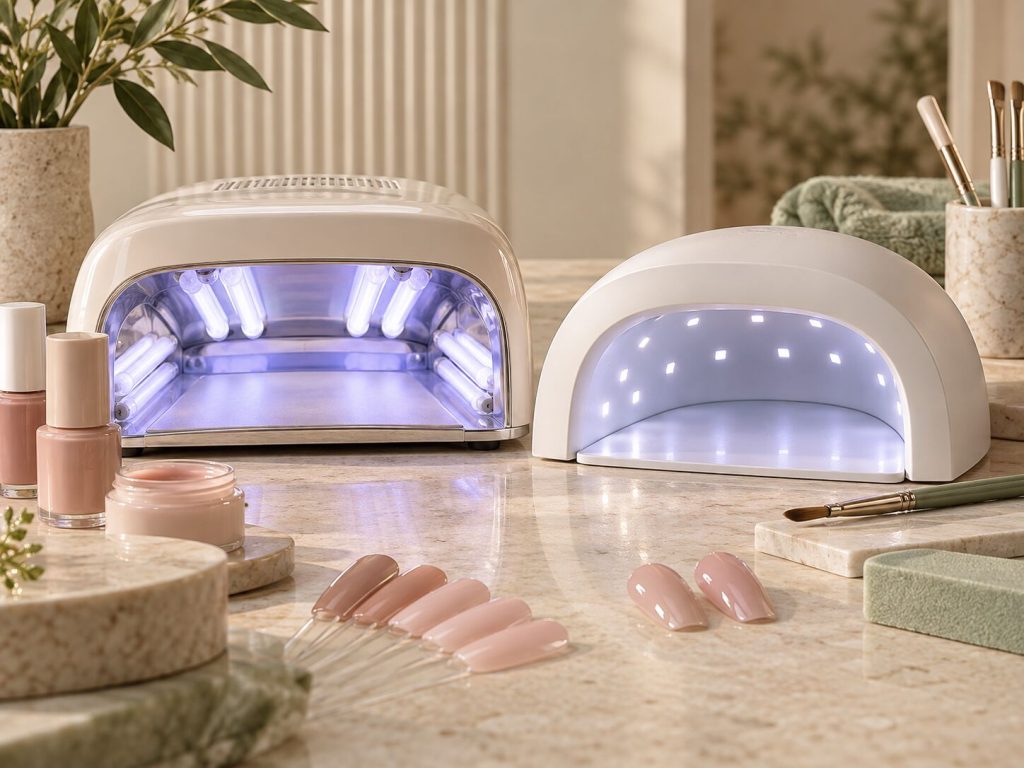
Choosing a nail lamp sounds simple.
Find a powerful lamp, put the hand inside, cure the gel and move on.
But curing is one of the most misunderstood parts of a gel service.
A lamp can turn gel from liquid into an apparently hard material, but that alone does not tell you everything about how well the product has polymerized.
And one of the biggest mistakes nail technicians make is choosing a lamp based almost entirely on one number:
Wattage.
A 48W lamp is not automatically better than a 36W lamp.
And a lamp marketed as “LED” is not automatically compatible with every gel labelled LED.
To understand why, we need to look at what is actually happening during curing.
Gel Does Not Dry — It Polymerizes.
UV/LED gel does not dry through evaporation like traditional nail polish.
Instead, it cures through a chemical reaction called polymerization.
Inside the gel are molecules called photoinitiators.
When photoinitiators absorb the appropriate light energy, they help initiate the chemical reaction that transforms the uncured material into a polymer network.
This means the gel and the lamp are not two unrelated products.
They work as a system.
The lamp must deliver light that is appropriate for the photoinitiator system contained in the gel, for an appropriate amount of time and energy.
That is why curing should never be reduced to:
“I put it in the lamp and it became hard.”
UV vs LED: What Do These Terms Actually Mean?
The terminology can be confusing.
Older professional nail lamps commonly used fluorescent UV bulbs.
Most modern nail lamps use LEDs as the light source.
But an LED nail lamp can still emit ultraviolet light.
In other words:
LED describes the technology producing the light. It does not automatically mean “no UV.”
Modern professional nail lamps may emit light around wavelengths such as 365 nm and 395–405 nm, depending on the system.
The wavelength required depends on the photoinitiators used inside the gel formulation.
This is why the better professional question is not:
“Which lamp cures everything?”
It is:
“Which lamp has been designed or validated to cure the gel system I am using?”
Why Wattage Is Not the Most Important Number.
Wattage is one of the most visible specifications on a nail lamp.
36W. 48W. 54W. 80W. Sometimes even higher.
It is easy to assume:
More watts = stronger lamp = better cure.
But wattage alone does not tell you how effectively the curing light reaches and polymerizes the gel.
Several other factors influence curing, including:
- wavelength
- irradiance at the nail surface
- LED positioning
- distance between the nail and the light source
- exposure time
- internal lamp design
- product thickness
- pigmentation
- the photoinitiator system inside the gel
This is why comparing lamps only by wattage can be misleading.
A lamp should be evaluated as part of a curing system, not simply by the largest number printed on the box.
Wavelength Matters.
Light exists at different wavelengths, measured in nanometers, or nm.
Different photoinitiators absorb light differently.
That means the wavelength emitted by the lamp must correspond appropriately with the photoinitiator system in the product.
Many contemporary professional nail lamps use more than one wavelength range in order to work with modern gel formulations.
But seeing “365 + 405 nm” on a lamp does not automatically mean it is suitable for every gel product on the market.
The gel manufacturer should provide information about the lamp or curing conditions recommended for the product.
That information is much more useful than simply choosing a lamp because the packaging says “UV/LED compatible.”
Why the Manufacturer’s Lamp Matters.
Professional gel systems are often developed and tested together with a specific curing lamp.
There is a reason for this.
A manufacturer can test variables such as:
- lamp output
- wavelength
- curing time
- gel formulation
- recommended application thickness
- pigmentation
- curing protocol
This creates a system in which the manufacturer knows how the product is intended to perform.
This does not necessarily mean that another lamp could never cure the product.
It means that unless another lamp and product combination has been properly tested, you may not know whether you are reproducing the curing conditions intended by the manufacturer.
For professional work, that uncertainty matters.
“But the Gel Feels Hard”.
This is where curing becomes deceptive.
A product can feel hard on the surface without that alone proving that the entire applied layer has reached the intended level of cure.
Several factors can influence this.
Product Thickness
Light has to travel through the gel.
Very thick layers can make effective curing more difficult.
This is particularly important when working with builder gels, hard gels and structural applications.
More product does not mean that you should automatically increase the curing time and assume the problem is solved.
Application thickness should follow the manufacturer’s instructions.
Pigmentation
Pigments can influence how light travels through the material.
Highly pigmented products may behave differently from clear or translucent gels.
Very dark, very light or highly opaque colors may require particularly careful attention to layer thickness and the manufacturer’s curing protocol.
Hand Position
Even a high-quality lamp cannot cure an area effectively if the light does not reach it properly.
Thumbs are a common example.
If the thumb is tilted away from the LEDs, it may receive different light exposure from the other fingers.
Correct hand placement inside the lamp is therefore part of correct curing technique.
Under-Curing Is More Than a Retention Problem.
When curing is inadequate, the problem is not simply that the manicure may chip, lift or break down prematurely.
Before proper polymerization, gel contains reactive ingredients.
Correct curing is therefore part of responsible professional product use.
This connects directly with the discussion around acrylates, methacrylates, HEMA and sensitization.
A professional nail technician should focus on:
- avoiding skin contact
- applying products at the recommended thickness
- using the appropriate curing lamp
- following the recommended curing time
- working within the manufacturer’s system whenever possible
If you want to understand this subject in more depth, read HEMA, Gel Allergies & Sensitization: What Every Nail Tech Should Understand.
Can You Cure Longer to Fix the Wrong Lamp?
This is another common assumption.
“If my lamp is not powerful enough, I’ll just cure for longer.”
That is not a reliable professional rule.
Correct curing depends on several variables working together:
Wavelength + irradiance + exposure time + formulation + application.
If the lamp does not provide appropriate light for the photoinitiator system being used, simply extending the curing time does not automatically reproduce the conditions intended by the manufacturer.
Curing time should therefore not be guessed.
Follow the curing protocol specified for the product whenever possible.
What About Low Heat Mode?
Many modern professional lamps include a low heat mode.
This can make curing more comfortable when working with larger amounts of builder gel or hard gel.
Polymerization is an exothermic reaction, meaning heat can be released as the material cures.
When a larger amount of product polymerizes rapidly, the client may sometimes experience a sudden feeling of heat commonly called a heat spike.
Low heat modes are designed to control how the lamp delivers energy during the curing cycle, helping make the process more comfortable.
But low heat mode should still be used according to the gel and lamp manufacturer’s instructions.
Client comfort should never be achieved by simply shortening the curing time without understanding the product.
Does More LEDs Mean Better Curing?
Not automatically.
The number of LEDs may influence coverage, but their placement is also important.
A lamp should provide appropriate light exposure across the entire hand, including:
- the center of the nail
- sidewalls
- free edge
- thumb
- lateral areas
Two lamps with similar wattage and a similar number of LEDs can still distribute light differently.
Internal lamp design matters.
Again, no single specification should be used in isolation to determine whether a lamp is suitable.
What Should a Nail Tech Look for in a Lamp?
Instead of asking only:
“How many watts is it?”
Ask:
- Which gel system is this lamp designed for?
- Which wavelength range does it emit?
- Has the manufacturer tested it with the gels I use?
- What curing times are specified?
- Does the lamp provide good coverage across the entire hand?
- Can the thumb be positioned correctly?
- Does the manufacturer provide technical specifications?
- Are professional instructions and support available?
For a professional nail technician, transparency from the manufacturer is valuable.
A lamp should not be chosen only because it is inexpensive, powerful or trending online.
It should be chosen because it is appropriate for the system you are using.
What About UV Exposure?
Nail curing lamps that emit ultraviolet light expose the skin of the hands to UV radiation during the service.
The American Academy of Dermatology recommends that clients who want additional skin protection during gel manicures can apply a broad-spectrum, water-resistant SPF 30 or higher sunscreen to the hands before the service, or wear dark, opaque fingerless gloves that leave only the nails exposed.
For nail professionals, the important principle is not to create unnecessary fear around nail lamps.
It is to understand the equipment being used and to give clients accurate information.
Nail Lamp Technology Continues to Evolve.
Curing technology continues to develop.
Manufacturers are researching and introducing new combinations of lamps, photoinitiators and light-curing systems.
This is another reason professional education should not stop at memorizing:
“60 seconds in the lamp.”
Products change.
Formulations change.
Regulations change.
Technology changes.
Understanding the principle behind curing allows a nail technician to adapt as the industry evolves.
The Takeaway.
A nail lamp is not simply a box that makes gel hard.
It is part of the chemistry of the service.
Wattage alone does not tell you whether a lamp will cure your gel correctly.
Wavelength matters.
Lamp output matters.
Product thickness matters.
Pigmentation matters.
Exposure time matters.
Hand positioning matters.
And most importantly, gel-and-lamp compatibility matters.
Instead of looking for the most powerful lamp on the market, look for the lamp that is appropriate for the professional gel system you use.
Because proper curing is not simply about better retention.
It is part of understanding your product — and using it professionally.