
If you have ever shopped for professional nail products, you have probably seen the terms hard gel, builder gel, builder in a bottle, BIAB, structure gel, and sculpting gel used almost interchangeably.
And this is where the confusion starts.
The most important thing to understand is this:
“Builder gel” usually describes what the product is designed to do. “Hard gel” describes more about the type of system and how it behaves.
That means a builder gel can be a hard gel — but not every builder gel is necessarily a hard gel.
What Is Builder Gel?
A builder gel is a gel with enough body and strength to create structure.
Instead of simply applying color, a nail technician can use builder gel to:
- reinforce the natural nail
- create an apex
- correct the architecture of the nail
- add strength to a structured manicure
- create short extensions
- or, depending on the product, sculpt longer extensions
“Builder” therefore refers largely to the function of the gel.
But builder gels can come in very different formulations.
Some are soak-off.
Some must be filed off.
Some are extremely flexible.
Others are much harder.
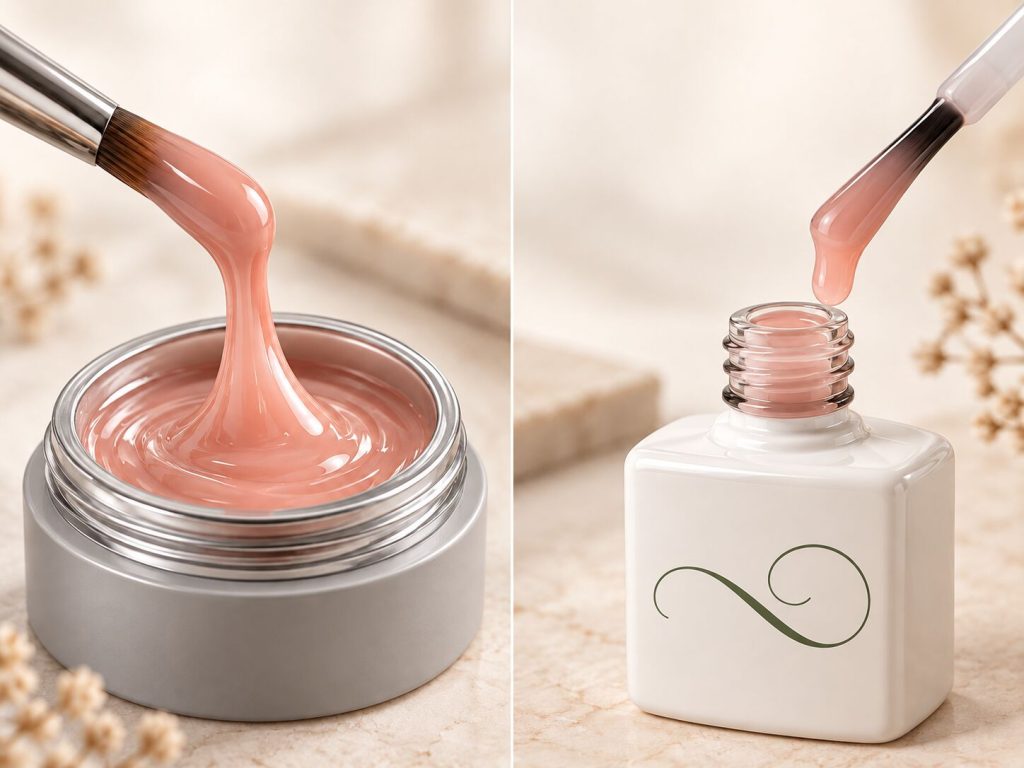
Some come in bottles with a brush, while others come in pots.
This is why the word builder alone does not tell you everything you need to know about a product.
What Is Hard Gel?
Hard gel is a light-cured gel system designed to create durable nail enhancements and structure.
Unlike soak-off gels, traditional hard gels are generally file-off products. They do not simply dissolve away in acetone.
They are often used for:
- sculpted extensions
- longer salon shapes
- structural corrections
- overlays that require greater rigidity
- rebuilding damaged corners
- clients who need more support
Professional gel brands themselves distinguish between soak-off builders and hard builder systems. For example, Light Elegance categorizes its Lexy Line as hard builder gel while its JimmyGel is a soak-off builder gel, illustrating why “builder” and “hard gel” should not automatically be treated as synonyms.
Builder Gel Does Not Always Mean “Soft”.
This is another common misunderstanding.
A builder gel in a bottle is often more flexible than a traditional hard gel, but you cannot determine the strength or flexibility of a product simply from its packaging.
A bottle does not automatically mean soft.
A pot does not automatically mean hard.
What matters is the formulation.
You need to know:
- Is the product soak-off or file-off?
- How flexible is it after curing?
- Is it designed for natural nail overlays or extensions?
- How much length can it safely support?
- What type of base does the manufacturer recommend?
- What lamp and curing time are required?
These questions tell you far more than the product name alone.
What About Builder in a Bottle?
Builder in a bottle — often shortened to BIAB, although BIAB is also associated with specific branded terminology — has become extremely popular because of its speed and convenience.
The brush-on format allows nail technicians to create a structured overlay without working from a traditional gel pot.
These products are often:
- self-leveling
- faster to apply
- ideal for natural nail services
- suitable for short to medium lengths
- and, in many systems, soak-off
That makes them extremely useful in salon environments.
But convenience does not mean every builder in a bottle should be used for every client or every length.
A client wearing short natural nails has very different structural requirements from a client wearing a long almond or square extension.
Structure Matters More Than Product Thickness.
One of the biggest mistakes beginner nail technicians make is thinking:
“If I apply more gel, the nail will be stronger.”
Not necessarily.
Strength is not created simply by adding thickness everywhere.
The product needs to be placed correctly.
A structurally balanced enhancement considers:
- the apex
- the stress area
- the free edge
- the sidewalls
- the natural nail shape
- the final length
A thin nail with correct architecture can perform much better than a thick nail with poorly placed product.
This is why understanding structure is far more important than memorizing how many layers of gel to apply.
Which One Should You Choose?
There is no single gel that is perfect for every service.
For a short natural nail overlay, a flexible soak-off builder may be an excellent choice.
For a longer sculpted extension, a hard gel may provide the stability and architecture required.
For a client with very flexible natural nails, choosing an extremely rigid system without considering how the natural nail moves may create problems.
For another client, a product that is too flexible may not provide enough support.
The goal is not to ask:
“Which gel is the best?”
The better question is:
“Which gel is appropriate for this nail, this length, this structure, and this client?”
Even the right gel system can fail if the nail is not prepared correctly.
Always Learn the System, Not Just the Product Name.
Professional gels are designed as systems.
The bonding product, builder, color, top coat and lamp may all be formulated to work together.
That is why you should always read the manufacturer’s instructions rather than assuming that every gel behaves the same way.
Pay attention to:
- recommended lamp
- curing time
- application thickness
- compatible base products
- removal method
- intended service type
A beautiful jar of gel tells you very little.
Understanding how that gel behaves tells you everything.
The Takeaway.
Hard gel and builder gel are related terms, but they are not identical.
Builder gel describes a gel designed to build structure.
Hard gel describes a more rigid, traditionally file-off gel system used for durable enhancements.
Some builder gels are hard gels.
Others are flexible soak-off systems.
As a nail technician, learning to identify the difference allows you to choose products based on performance rather than marketing terminology.
And that is one of the most important shifts you can make as you move from simply following steps to actually understanding your products.