
Gel allergies have become one of the most discussed subjects in the nail industry.
And unfortunately, one of the most misunderstood.
HEMA is often blamed as if it were the only ingredient capable of causing an allergic reaction, while products labelled “HEMA-free” are sometimes assumed to be completely allergy-safe.
Neither idea tells the whole story.
To work safely and professionally with gel products, nail technicians need to understand what HEMA is, how sensitization can develop, and why correct application and curing matter just as much as the ingredient list.
What Is HEMA?
HEMA stands for 2-Hydroxyethyl Methacrylate.
It is a small methacrylate monomer that has been used in different light-curing nail products because it can contribute to properties such as adhesion and product performance.
But HEMA is only one member of a much larger family of acrylate and methacrylate ingredients.
This distinction is important.
A nail product may be HEMA-free while still containing other acrylates or methacrylates.
So:
HEMA-free does not mean acrylate-free.
And it does not mean that an allergic reaction is impossible.
If you want to understand the different ingredient categories found inside nail gel, read What’s Really Inside Nail Gel? Understanding the Ingredients Behind Your Products.
What Is Sensitization?
An allergic reaction is different from simple irritation.
Irritant contact dermatitis happens when a substance damages or irritates the skin.
Allergic contact dermatitis, on the other hand, involves the immune system.
A person may be exposed to a substance repeatedly before becoming sensitized.
Once sensitization has developed, later exposure to the allergen may trigger an immune reaction.
This is one reason professional prevention matters so much.
You cannot look at someone’s skin and predict with certainty who will or will not eventually become sensitized.
Why Uncured Gel on the Skin Matters.
One of the most important professional rules is simple:
Uncured gel belongs on the nail plate, not on the skin.
Before polymerization is complete, the product still contains reactive ingredients.
Repeated skin exposure to uncured or insufficiently cured nail products can increase the opportunity for sensitization.
This is why flooding the cuticle is not simply an aesthetic problem.
It is a product-safety problem.
Clean application should therefore include:
- controlling the amount of product
- keeping gel away from the surrounding skin
- avoiding repeated flooding of the cuticle and sidewalls
- removing accidental skin contact before curing
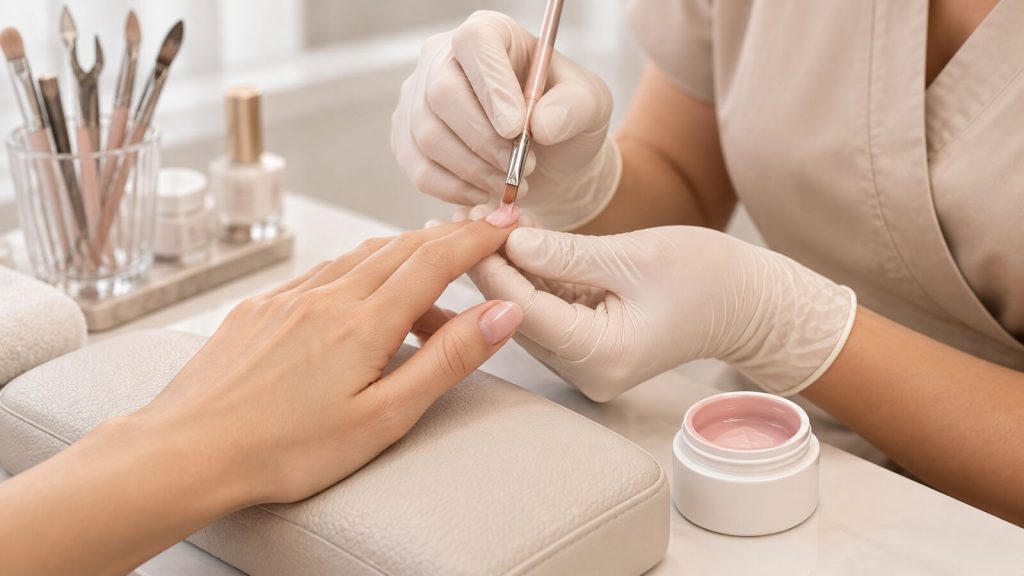
- working with enough precision that product does not repeatedly touch the client
A clean application is not only prettier.
It is part of professional product handling.
Why Correct Curing Matters Too.
Avoiding skin contact is only one part of the equation.
Gel products also need to be properly polymerized.
A gel that looks hard on the surface is not necessarily proof that the product has reached the level of cure intended by its manufacturer.
The polymerization process depends on several variables, including:
- the formulation
- the photoinitiator system
- lamp wavelength
- exposure time
- product thickness
- pigmentation
- the lamp/product compatibility
This is why using a random lamp simply because it has a high wattage is not good professional practice.
Your lamp and your gel should be treated as a system.
Whenever possible, follow the curing instructions and lamp recommendations provided by the manufacturer.
HEMA Regulation in Europe.
HEMA has received particular attention in Europe.
Under European Union cosmetic regulations, nail products containing HEMA or Di-HEMA Trimethylhexyl Dicarbamate are restricted to professional use only.
These products must also carry the warnings:
“For professional use only”
and
“Can cause an allergic reaction.”
This does not mean HEMA has been completely banned from professional nail products in Europe.
It means its use in this category is subject to specific restrictions and warnings.
For nail technicians, this is an important distinction between an ingredient being restricted and an ingredient being prohibited.
HEMA-Free Does Not Mean Allergy-Free.
This is perhaps the most important misconception to correct.
A product can be formulated without HEMA and still contain other reactive acrylates or methacrylates.
Therefore, changing to a HEMA-free product does not eliminate the need for:
- precise application
- correct curing
- avoiding skin contact
- reading ingredient lists
- following manufacturer instructions
“HEMA-free” tells you something specific about the formulation.
It does not tell you that the entire product is incapable of causing sensitization.
Be careful with marketing terms such as:
- allergy-free
- non-toxic
- chemical-free
- completely safe
Professional product assessment should go beyond the front label.
What Can an Allergic Reaction Look Like?
Allergic contact dermatitis does not always appear in exactly the same way.
Possible symptoms can include:
- itching
- redness
- swelling
- dry or cracked skin
- blistering
- irritation around the fingertips or nail folds
And reactions connected to nail cosmetics do not necessarily stay around the nails.
Contact allergens transferred from the fingers can sometimes cause dermatitis elsewhere, including areas such as the eyelids or face.
A nail technician should not attempt to diagnose an allergy.
If a client or nail professional develops a persistent or suspected allergic reaction, the appropriate step is to stop exposure to the suspected product and seek assessment from a qualified healthcare professional or dermatologist.
Can You Simply Switch to Another Gel?
Not necessarily.
If someone has developed an acrylate or methacrylate allergy, switching randomly between brands is not a reliable solution.
Different products can contain different reactive ingredients, and a person may react to more than one substance.
Determining the responsible allergen may require patch testing performed by a dermatologist or appropriate medical professional.
This is another reason why telling someone:
“Just use a HEMA-free gel.”
can be an oversimplification.
The question is not simply which brand to buy next.
The question is which substance caused the reaction.
Nail Techs Are Exposed Too.
Product safety is not only about the client.
A nail technician can work with uncured gel products repeatedly, day after day.
That makes professional working habits particularly important.
Avoid getting uncured gel on your own fingers while cleaning brushes, bottles or product containers.
Keep the outside of bottles and jars clean.
Do not use your bare finger to remove excess gel.
Replace contaminated gloves when necessary.
And treat repeated accidental product contact as something to correct — not as a normal part of doing nails.
Precision protects both the client and the technician.
Professional Technique Is Part of Product Safety.
There is a tendency in the nail industry to divide education into two categories:
technique and safety.
In reality, they are connected.
Controlling product around the cuticle is technique.
Selecting the correct lamp is technique.
Applying the correct thickness is technique.
Understanding ingredients is technique.
Following curing instructions is technique.
Professional nail work is not only about producing a beautiful final photograph.
It is about understanding the material you are working with and using it correctly.
The Takeaway.
HEMA is an important ingredient to understand, but it should not become the entire conversation about gel allergies.
The bigger picture includes:
reactive acrylates and methacrylates, skin exposure, correct curing, product compatibility, professional application and education.
Choosing a HEMA-free product may be appropriate in some situations, but it does not replace good technique.
The goal should not be to become afraid of nail chemistry.
The goal is to understand it.
Because the more you understand your products, the better decisions you can make for yourself, your clients and your work.